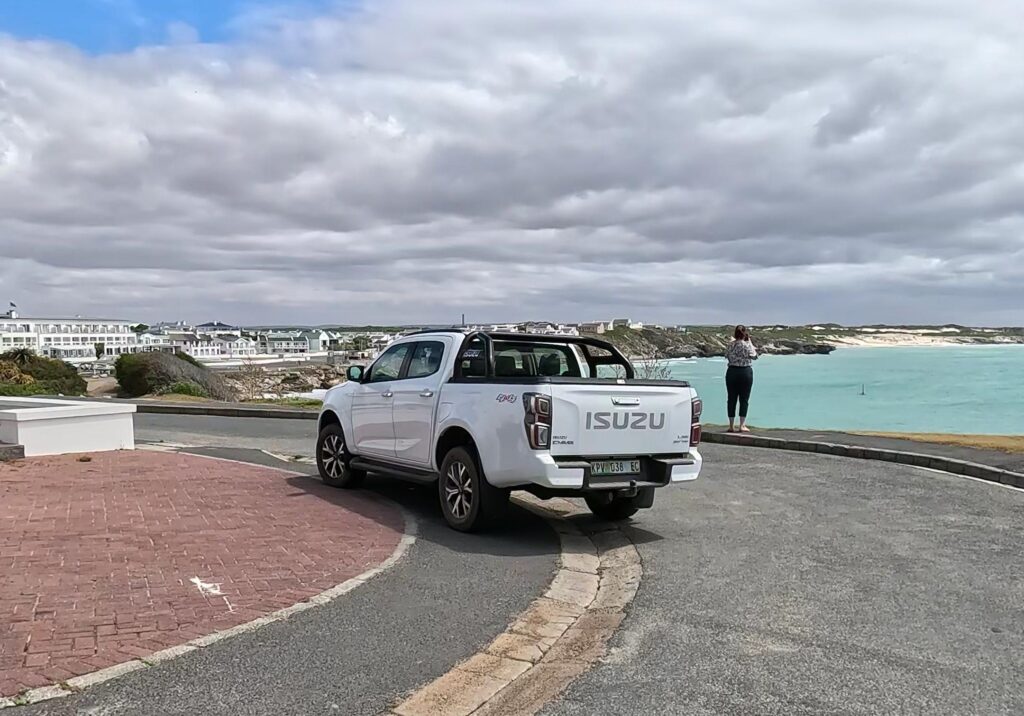
Isuzu is no stranger when it comes to the bakkie market in Southern Africa, boasting one of the widest ranges on offer. The manufacturer also recently toppled Ford’s Ranger to become the second highest bakkie seller in South Africa; and with good reason.
Isuzu offers more than 10 single-cab options, six expanded cab options, and a mesmerising 19 double-cab bakkies. This is largely thanks to the November addition of two new D-MAX Black models.
All three of the cab conversions can be purchased with a newer (and more fuel efficient) 1.9L Turbo Diesel engine (110kW and 350 Nm). While this engine lacks some power, we are used to seeing it in most Isuzus, as it can cover quite extensive distances. A fellow motoring journalist even took one of the single cab 1.9L bakkies all the way from Johannesburg to Cape Town (roughly 1 400km) on one single tank of diesel. Then there is the proven 3.0L engine (140kW and 450 Nm), which has been Isuzu’s most reliable and powerful engine for quite some time.

With this in mind, prices for the Isuzu bakkie range kick off at R373,750 for a single-cab D-Max 250 C Standard Gen 6. From there on, prices range all the way through both 4×2 and 4×4 options as well as manual and automatic, in different specifications, such as L, LS, LSE, X-Rider, V-Cross and the flagship Arctic Trucks AT35, priced at R1 194 000.
Essentially, the 3.0-litre engine in all trim levels adds roughly R110 000 to the price of its 1.9 TD equivalents. However, the payoff is a considerable amount of torque with the 3.0-liter engines, strong enough to better act as a workhorse on the farm, or pull heavier items such as larger caravans.
Our test unit
All-in-all, there are 35 bakkies to choose from, before going into more detail such as 4×4 and transmission choices. One single article is not nearly enough to spend time on all of these models, so instead, we’ll focus on the recent test unit we had, namely the 3.0 Ddi 4×4 LSE automatic, which can be purchased for R887 000. Its 4×2 equivalent is priced at R838 300.
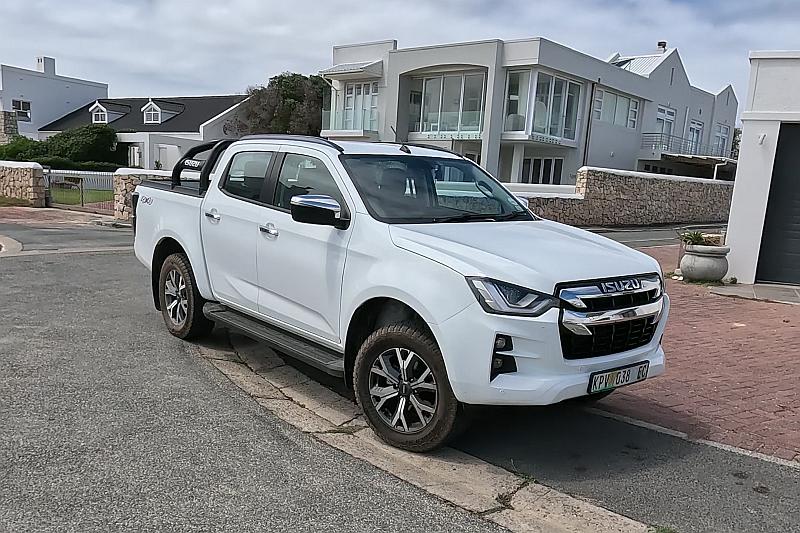
Sitting above the LS, and underneath the V-Cross and Arctic Trucks options, the LSE is the third highest-ranked in the hierarchy. It is therefore considered to be one of Isuzu’s “fancier” double-cabs, aiming to merge its workhorse abilities with ‘acceptable’ behaviour around town.
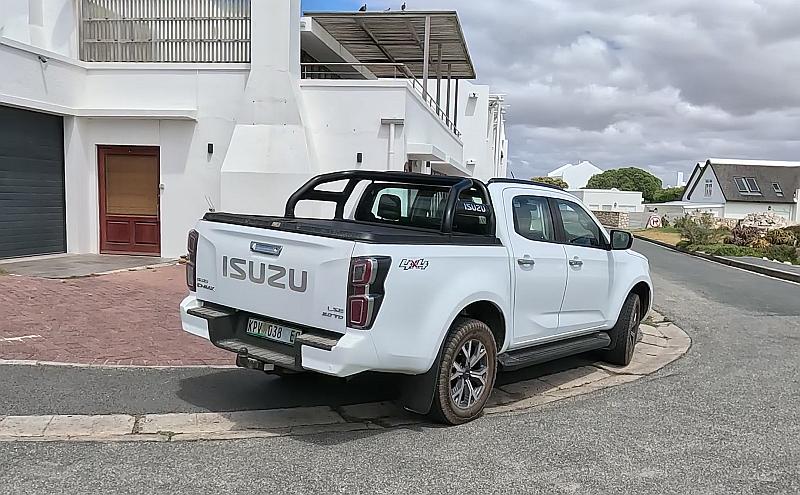
The V-Cross derivatives, for instance, focus more on black exterior accents, whereas the LSE opt for silver /chrome trims around the exterior of the bakkie. Another feature of the LSE is its daytime running lights, which are missing from models below it.
Furthermore, the LSE also comes with 18-inch alloys, complete with all-terrain General Grabber tyres.
Other features include keyless entry and a sports bar at the back. Our test unit also came with an optional roller-shutter, which closes off the loading bay.
Exterior colours range from a basic Splash White to Red Spinel, Mercury Silver, Biarritz Blue, Islay Grey, and the new Onyx Black.
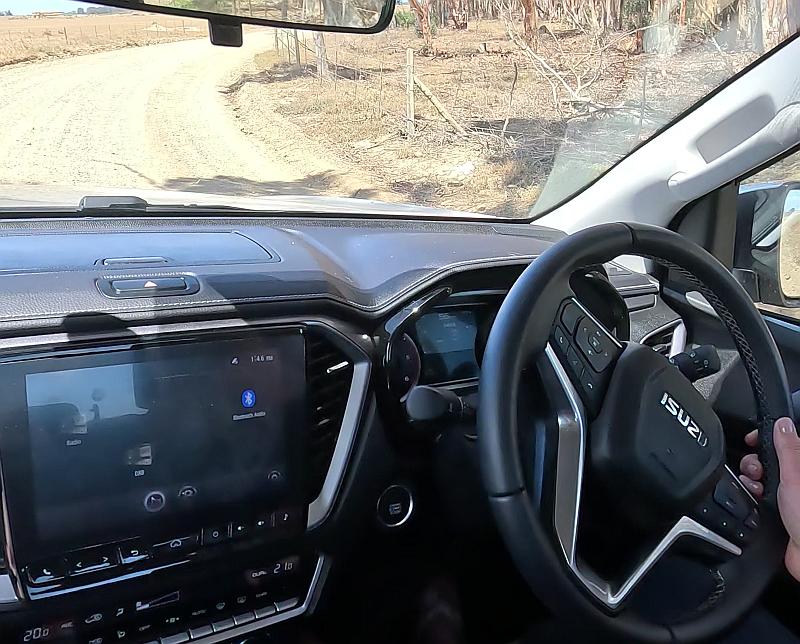
Isuzu follows a similar philosophy to Toyota when it comes to the interior, as the they tend to focus more on the engine and its overall capabilities. The interior is minimalist yet practical, with analog dials and a small LCD screen, showing driver information such as fuel consumption and engine temperature. Similarly, a nine-inch infotainment screen in the center can be wirelessly paired with any smartphone, while a USB-A and 12V point in the front also help with connectivity. Another USB-A charging port is available to occupants of the second seating row.
The cabin is a combination of durable plastics and stitched leather, with all seats being covered in leather.
While the performance of the LSE might struggle to keep up with most of its competitors, the 3.0L in the LSE is not only durable, but also capable of doing the work expected of it. Similarly, its six-speed automatic gearbox proves to be much better than some of the latest automatic gearboxes, which tend to be jerky and more focused on shorter gearing.
The 3.0L in the LSE also means that it can tow more (750kg unbraked and 3500kg braked) than its 1.9L equivalent, while the 3.0L single cab and extended cab bakkies tend to carry a higher payload, compared to the 995kg of the double cab.
Lastly, the LSE also comes with cruise control (not adaptive), ABS with EBD, Brake-Assist System, ESC, Hill start assist, Hill descent control, trailer sway control, driver, passenger, front seat side, curtain and knee airbags. It has parking distance sensors, a rear-view and front camera, blind spot monitor, rear radar, forward collision warning, lane-departure warning and lane keep assist, as well as ISOFIX child anchor points.
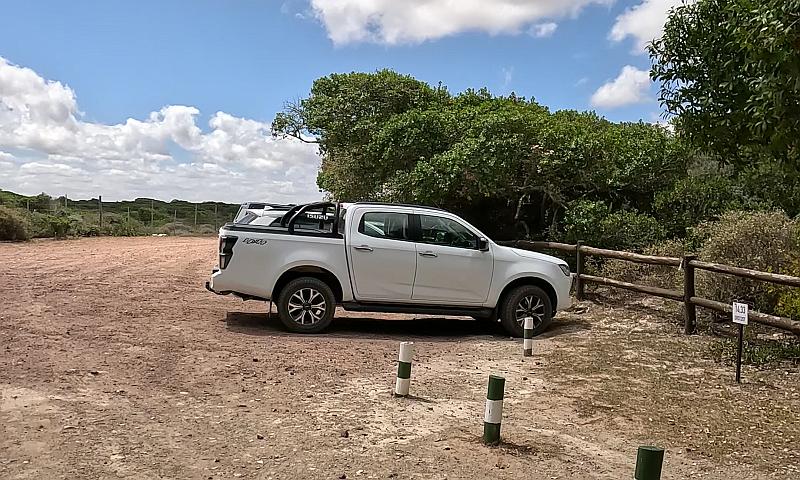
Overall, the LSE model might not be the most luxurious of all its competitors, yet does provide good value for money.
Let’s compare the Isuzu D-Max LSE to some of its closest rivals:
| Model | Price (R) | Power / Torque | Combined consumption | Payload | Warranty |
| Isuzu D-MAX 3.0TD LSE | 887 000 | 140kW and 450 Nm | 8.0L / 100km | 995kg | 5 year / 120 000 km |
| Toyota Hilux 2.8GD-6 Legend | 935 900 | 150kW and 500 Nm | 8.0L /100km | 1010 kg | 3 year / 100 000km |
| Ford Ranger 2.0 BiT XLT (10 speed auto) | 868 500 | 154kW and 500 | 7.2L /100 km | 946 kg | 4 year / 120 000km |
The Isuzu LSE, compared to its two main rivals, namely the Hilux and the Ranger, is certainly under-powered, and while the BiTurbo of the Ranger gives a better fuel economy, the Isuzu delivers a very good real-life fuel consumption, while the Hilux and the Ranger both edge closer to 8.5L/100km.
Similarly, the LSE seems to have the best solution when it comes to its warranty.
While all eyes are certainly on the latest Hilux generation, the new Ford Ranger also offers the best when it comes to interior quality, fuel efficiency and rapid acceleration. Yet, the D-MAX LSE seems to be the logical sense when it comes to the overall package.
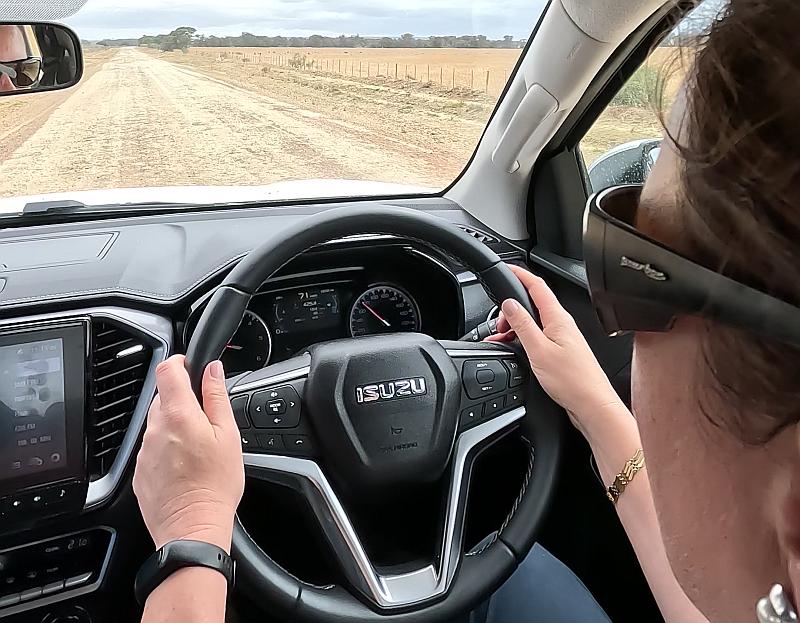
By this time, its 3.0L engine has already been proven to be both reliable and a hard-worker. Similar to other Japanese manufacturers, Isuzu is also not overly concerned with interior aesthetics, but rather in ensuring that it does what it is asked, for as long as possible; something the LSE does very well.
The LSE will surely not win the beauty pageant or a bakkie drag race (click here for a summary of all our turbo-diesel bakkie acceleration data!) yet will do what is required, either in or outside of the city, for as long as possible.
There is a good reason why Isuzu is doing so well in South Africa and Namibia at the moment!